Beloved, although I was very eager to write to you about our common salvation, I found it necessary to write appealing to you to contend for the faith that was once for all delivered to the saints (Jude 3).
The Gospel of the Lord Jesus, delivered to the saints of all ages by the authorized apostles of Christ, has always been under malicious, sometimes insidious, attack.
The Pharisees of Jesus’ time – those thought by the majority to be most religious – demonstrated vehement and often violent opposition to the Gospel of Christ.
And when it was clear that the Gospel could not be eradicated, the Judaizers of the 1st century apostolic age forcefully advanced a syncretism of watered-down Gospel injected with a strong dose of Jewish legalism.
The Gnostics – heavily influenced by Greek metaphysics – were a full-blown hazard in the mid-2nd century, but the roots of Gnosticism were evident a century before in the age of the apostolic church. The Gnostic worldview was framed on an unbiblical dualism which denied the Incarnation of Christ. In addition, their elitist self-description as pneumatikoi – or spiritual ones – dismissed any apostolic utterance that clashed with their elitist perceptions.
In the 21st century, the malicious peril exists in this deceptive, contemporary and malignant strain: liberal Christianity, often branded as progressive. It poses an insidious threat because it comes from within theological circles. Last century, it was called modernist; earlier this century, it was labelled emerging.
Despite numerous branding tags, like the spiritual cancer it is, progressive Christianity must be recognized and boldly confronted as Jude warned in verse 4 of his epistle:
For certain people have crept in unnoticed who long ago were designated for this condemnation, ungodly people, who pervert the grace of our God into sensuality and deny our only Master and Lord, Jesus Christ (v.4).
Professor of New Testament and early Christianity Michael Kruger, whimsically summarizes the essence of liberal theology: “Essentially, it’s the gospel according to Santa Claus.”
Here are 4 characteristic identifying markers of the progressive/liberal/ emergent/ modernist variety, which as Paul would emphatically declare is a different gospel—which is really no gospel at all. (Galatians 1:6,7):
1) Liberalism seeks to undermine the authority of Scripture. Modernists ask, “can a compilation of books from 2 millennia ago really speak to the needs, wants, desires and issues of life-complexity experienced by people today”? The question implies a negative response. And so progressives seek to “initiate conversations”, to “enlarge understanding” of human experience rather than humbly apprehending the eternal truth of the Word of God.
2) Liberalism denies the holiness of God. Progressive Christianity dismisses the God of the biblical narrative and ignores His holy character. “People need to be affirmed, not judged by a rigid and inflexible standard”, they declare! Or, “affirming people’s potential is to be preferred over reminding them of their brokenness and sin”. And thus is promoted the horizontal relationships – people to people – as being of greater consequence than the vertical relationship with a God who is distant, demanding and holy.
3) Liberalism rejects righteousness in favour of morality; existential relativism rears its ugly head. “After all”, the progressives opine, “shouldn’t standards of right and wrong be fluid and in keeping with humanity’s cultural evolution?” But what is obvious is that because biblical righteousness is unchanging and rooted in the very character of eternal God, an ever-evolving form of man-made morality is the proverbial wax nose, constantly conforming to the whims of a changing ethical landscape, particularly on issues of gender and sexuality.
4) Liberalism diminishes the Person and work of Christ. To the progressives, Jesus is a useful example of speaking truth to power, of selfless humility, and of moral instruction – but nothing more. Their theology considers Jesus’ claims to deity, to being the sole avenue to God, and to being the Personification of Truth, to be irrelevant at best and dangerously judgemental and gravely harmful to the principles of pluralism and inclusiveness.
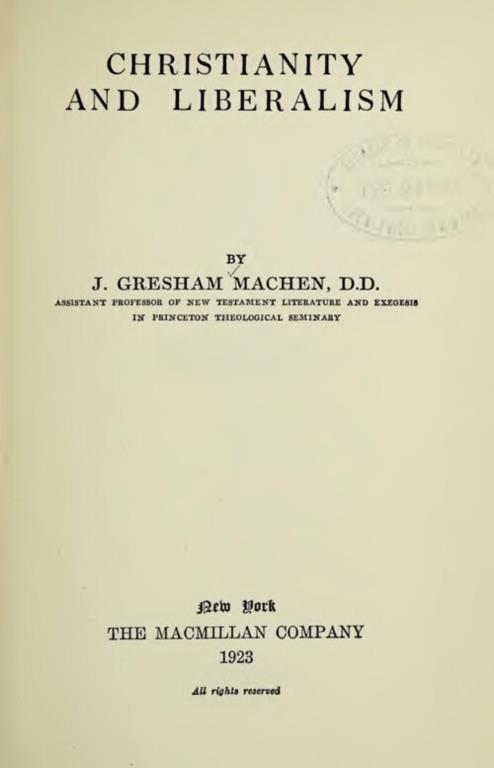
A century ago, J. Gresham Machen published an important argument against the Gospel drift of that era, Christianity and Liberalism (1923.
Machen observed: “The truth is that the life-purpose of Jesus discovered by modern liberalism is not the life-purpose of the real Jesus, but merely represents those elements in the teaching of Jesus—isolated and misinterpreted—which happen to agree with the modern program. It is not Jesus, then, who is the real authority, but the modern principle by which the selection within Jesus' recorded teaching has been made."
Takeaway: As in every era, biblical vigilance is required to apprehend Gospel truth.
And, as in every era, our hope is in Christ and our reliance on the Spirit indwelling each believer, relentlessly striving to guide into all truth (John 16:13).
To him who is able to keep you from falling and to present you before his glorious presence without fault and with great joy— to the only God our Saviour be glory, majesty, power and authority, through Jesus Christ our Lord, before all ages, now and for evermore! Amen (Jude 24,25).