She will
give birth to a son, and you are to give him the name Jesus, because he will save his people from their sins.” All
this took place to fulfill what the Lord had said through the prophet: “The virgin will conceive and give birth to a son, and they will call him Immanuel” [which means “God with us”] (Matthew 1:21-23).
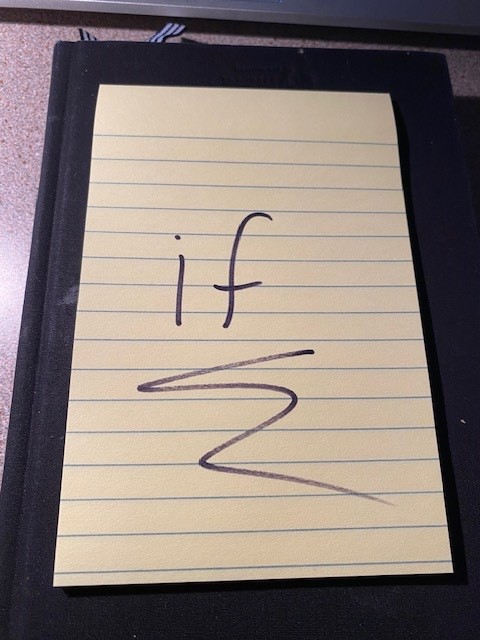
What comes to your mind when you hear this word in
isolation: if?
If you love
literature, you may recall the beloved Rudyard Kipling poem exhibiting
Victorian-era stoicism:
If you can
keep your head when all about you
Are losing theirs and blaming it on you,
If you can trust yourself when all men doubt
you,
But make allowance for their
doubting too;
If you can wait and not be tired by waiting,
Or being lied about, don’t deal in lies,
Or being hated, don’t give way to hating,
And yet don’t look too good, nor talk too wise.
If you’re of particular vintage, you might remember the pop music tune by David Gates and Bread entitled “If” from 1971, (incidentally, forever
entrenched in the Top 10 Shortest Title
song list).
But mostly the term is more mundane, simply used in
common speech, and often as a grammatical conjunction of condition: Wear your coat if it snows. Join the game if you want to. I’ll attend if you will.
Although the meaning is forgotten by many, Christmas is
the celebration of the epically historic juncture where God takes on
humanity, the enfleshment of Deity.
But at that time, there were many who should have recognized the event – the coming of the Messiah – but entirely ignored (or rejected) it.
Of all those in Hebrew history claiming to be the
Messiah, how would the spiritually vigilant people in Israel identify Him? Know
the authentic from the counterfeit? Confidently apprehend the genuine from
frequent imposters?
God, in the Old Testament, provided a bullet-proof
scheme.
Precise predictions. Markers of identity.
If He fits the prophecies, He’s the One.
Like a postage address.
When my sister lived in Japan, the population of Osaka
was approximately 17 million. And yet, I could confidently send her a letter or
parcel, if I had a very few key
pieces of information.
Of those millions of people, the envelope label
identified a single street; of the thousands on her street, a single building,
a single floor, and a single apartment. Of those in that unit, only she bore
the correct name.
If included,
those critical data pieces ensured correct identification.
If she
fulfilled each piece, she was the one.
Jesus of Nazareth was the most heavily anticipated Person
in history. And each prophecy built on the others to confirm His identity to
those who knew the word of the prophets of God.
If He fits the prediction, He’s the long-awaited One.
When one of our grandchildren was born, several friends and family started a “baby pool”. The game was simple – the winner was the one who most closely guessed the baby’s arrival date…and gender…and birthweight…and…
You get the picture. With each element added to the guess, the mathematical probability of being correct on all became less likely – exponentially less likely.
Some got the date correct, but the wrong gender. Or got
the first 2 right, only to miss by 2 or 3 pounds on predicting the birthweight.
In his gospel directed to a Jewish audience, Matthew alludes to – or quotes – 25 Messianic predictions from the Jewish Bible, our Old Testament. The chance of an individual fulfilling one or two was possible; but with each additional prediction, the probability factor diminished significantly.
Do you remember silver dollars coins?
It has been calculated that the chance of 1 person
fulfilling just 8 biblical predictive indicators would be 1 in 1017.
That would be analogous to pouring silver dollars over the province of Alberta – filling it to its borders to a depth of 2 feet. Then to illustrate probability, sending a blindfolded person wading into the pile, and hoping to find the single coin marked with an X on her first try.*
And that’s only 8. Bible scholars have identified 60 major prophecies, with another 270 ramifications.
Jewish-Christian scholar Alfred Edersheim (19th
century) has written that Jewish rabbis have identified 456 passages in the Old
Testament pointing to the Messiah.
The biblical account reveals that at the time of Jesus’ birth, Jewish experts in the Scriptures understood the signs, but failed to vigilantly investigate their fulfilment.
Herod the Great heard the rumor of the birth of the King
of the Jews and was deeply disturbed.
Matthew tells us, When [Herod] had called together all the people’s chief priests and teachers of the law, he asked them where the Messiah was to be born. “In Bethlehem in Judea,” they replied, “for this is what the prophet has written:
“‘But you, Bethlehem, in the land of Judah,
are by no means least among the rulers of
Judah;
for out of you will come a ruler
who will shepherd my people Israel’ (Matthew 2:4-6 NIV).
Takeaway: Those religious leaders understood predictive prophesy – but they missed the if factor.
It was – and is – an if/then equation.
If He fits the predictions – of location, family line, virgin birth, and many others including restoring sight to the blind, and David’s prediction (Psalm 22:16) of having His hands and feet pierced centuries before Roman crucifixion was invented – then He is unmistakably the One.
The Messiah. Emmanuel.
He is the enfleshment of God!
* Based on calculations by Peter Stoner, Professor Emeritus of Science at Westmont College - California); in his illustration Professor Stoner used the state of Texas.
` this post last appeared
in December 2022.