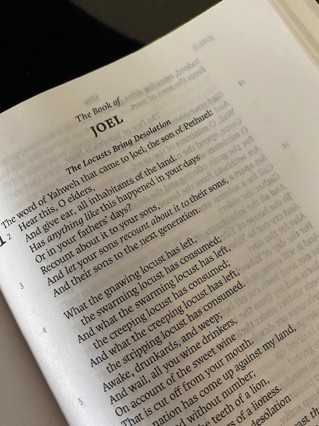
Hear this, you elders;
give ear, all inhabitants of the land!
Has such a thing happened in your days,
or in the days of your
fathers?
Tell your children of it,
and let your children tell
their children,
and their children to
another generation (Joel 1:2,3)
Why did the biblical writers frequently use poetry
to express their prophetic message to Israel and Judah?
Our current preaching series entitled, 12 in a minor
key, is a study of the Minor Prophets of the Hebrew Bible, our Old
Testament.
And The Twelve chose often to express their solemn
message via poetry.
These twelve prophetic oracles have been labelled minor
because of their relative brevity when compared to the major prophets Isaiah,
Jeremiah, Ezekiel and Daniel.
But we’ve used the analogy of the musical minor key to represent the threat of warning, the foreshadowed misery, all of which is conveyed in the sombre message of sadness, melancholy and gloom.
In the Hebrew Bible – the Tanakh – The Twelve are collected as sections in a single book. And Scholars of the Old Testament estimate at least 85% of these 67 chapters is written in poetic structure.
So why do the minor prophets often rely on poetry – rather than simple prose – to convey their dire prophetic alerts from the heart of Yahweh?
According to Brittanica, poetry is “literature that evokes a concentrated imaginative awareness of experience or a specific emotional response through language chosen and arranged for its meaning, sound, and rhythm”.
The following reasons have been suggested:
- poetry has the capacity to stir emotion deep
within the reader making the warnings and threats more memorable and vivid.
- Hebrew poetry, rather than employing rhyme or a clearly discernible cadence, relies on a rhythm of thought, particularly in its use of parallelism; in this way the contrast between God’s holy standard and the current sinful reality is more vibrantly graphic.
- the Hebrew
prophets utilize metaphors, similes, personification, and hyperbole to shock, convict and afflict the comfortable, and to comfort the afflicted.
- poetry
moves the reader to deliberate on the weight of actions and words, rather than merely
dismissing dry, wooden, propositional facts.
- prophetic
warnings of the future are more graphically, gut-wrenchingly apprehended by
poetically creating imagery of the mind.
-
and, in an oral culture, poetry enhances one’s ability to accurately memorize and relate poetic narrative in a striking manner intended to drive the Hebrew heart to carefully ponder God’s loving and faithful promises to Israel. Yahweh’s commitment to the descendants of Abraham was structured around His Covenant presence, protection, and provision, and each was in danger of imminent loss.
Takeaway: the Bible is a compilation – a library – of sacred texts, breathed out by the Holy Spirit of God to convey His exact truth, His comprehensive Self-revelation.
Because the
Bible employs various genres, we seek to observe, interpret, and apply to
understand what the original human author was conveying to that initial
audience by the eternal Word of God.
The literary genre of poetry was God’s chosen verbal vehicle.