For in the gospel a righteousness
from God is revealed, a righteousness that is by faith from first to last, just
as it is written: "The righteous will live by faith" (Romans 1:17).
Each year when the neighborhood children come to our door in their Hallowe’en celebration, I think of Martin Luther and the revolution of which he was a significant player.
That’s because many see October 31st as the
anniversary date of the beginning of Protestant Reformation.
Here’s why.
Brother Martin, an Augustine monk, was increasingly
distressed about what he saw in the church at Rome: the tolerating of clerical
abuses; the crass sale of indulgences thought to expedite the passage of loved
ones from purgatory; the power and excessive wealth of the pope; and what
Luther viewed as an accelerated drift away from the authority of Scripture.
Many of these issues intensified as greater irritants in subsequent years, but Luther put pen to paper to raise awareness for the hallowed eve (Hallowe’en) of All Saints Day, celebrated on November 1.
Consequently, his dissatisfaction crossed the line from
frustration to action on the final day of October 1517, now seen as the seminal
launch-date of the Reformation.
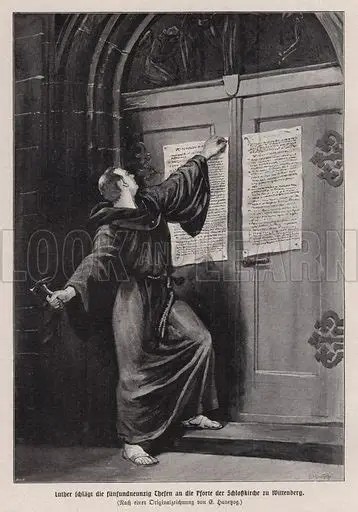
His form of protest was to nail his document – Ninety-Five Theses containing his observations critical of the pope and RC church practice – to the door of the Castle Church in Wittenberg, Saxony (modern day Germany).
In that culture, the church door was akin to a public
bulletin board.
But the people were ready for change, and in an astounding
example of 16th century “social media”, Luther’s document was translated from Latin to German, printed mechanically, and circulated throughout Germany within 2 weeks.
It was the topic of discussion in every pub in the land. By
the end of 30 days, it was being read all over Europe.
And in so doing, he unleashed a torrent whose theological,
social and political effects continue to be felt throughout the western world over
500 years later.
Luther was a scholar, a champion rebel-leader, a linguist, a
political reformer, and a powerful preacher-theologian; but I most admire that
he was used of the Lord to recover the Gospel of Christ in an era of profound
spiritual darkness.
Here’s what we need to understand as part of our Gospel worldview.
The objective cause of our salvation is the Person
and work of the Lord Jesus Christ; on that Rome and the Reformers agreed.
However, deep division and passionate – at times, very personal and violent – disagreement rested on what theologians refer to as the subjective
dimension.
In other words, the instrumental cause: how do we receive or appropriate the Gospel’s spiritual benefits and promised eternal life?? How are the benefits of Christ’s work applied to my life or yours? How does one enter into an eternal relationship with Almighty God?
The
RC church believed that these benefits accrued by way of the sacraments. There
were 7 such rites of which baptism and penance were key.
But
the Reformers pushed back with the cry of sola Scriptura – Scripture is our only and sole authority in matters of the Gospel. Unless our understanding of the Gospel is founded on biblical truth, then the traditions of men - including even papal assertions – are meaningless to it.
And,
somewhat ironically, the Word of God led Luther and the Reformers to the book
of Romans, written by Paul to the very city in which the Vatican enclave is
situated.
The righteous will live by faith from the first
chapter was the crux of salvation – to obtain it and to live it
out.
In his theological magnum opus, the Apostle Paul
continues: But now a righteousness from God, apart from law, has been made
known, to which the Law and the Prophets testify. This righteousness from God
comes through faith in Jesus Christ to all who believe. There is no difference,
for all have sinned and fall short of the glory of God, and are justified
freely by his grace through the redemption that came by Christ Jesus (Romans
3:21-24).
Luther and the Reformers were committed to the premise that God’s Gospel is predicated only and always on the Lord Jesus as revealed in the Scripture, given us by the Holy Spirit.
The Gospel of the 16th century had been
obscured by evolving traditions.
And, the basic doctrine of salvation was encrusted by
layers of political maneuverings and the lust for power and wealth, all of
which resulted in the suppression of biblical truth.
Luther helped to recover Gospel fidelity, simplicity and
clarity.
Takeaway: And therefore today we declare at
Bethel:
the Gospel is the proclamation of the good news,
of the Person and work of Christ,
and the eternal benefit to anyone responding to Him in
repentant FAITH!
~ my thinking on the Reformation has been assisted by RC Sproul’s lecture, What
is the Gospel?, Renewing Your Mind podcast, Ligonier.org
and by The
Legacy of Luther, a series of essays edited by RC Sproul and Stephen J
Nichols
- graphic
from lookandlearn.com
*this post
last appeared in October 2022