Of the increase of
His government and of peace there will be no end, on the throne of David and
over his kingdom, to establish it and to uphold it with justice and with
righteousness from this time forth and forevermore. The zeal of the LORD of
hosts will do this (Isaiah 9:7).
Israel
of the 1st century was at the epicenter of a highly-charged
political atmosphere, constantly on the verge of emitting seismic shock-waves
throughout the Mediterranean world.
Rome
ruled much of the known world with a fist of iron. And that fist was controlled
by Emperor Gaius Octavius.
He
was declared by his faithful senators to be deity; hence he became known as
Caesar Augustus.
Given
their rich spiritual history, the nation of Israel chafed under the Roman rule
of this man-god.
Jewish nationalism – heavily influenced by their religious conviction that they alone were God’s chosen people – caused Israel to be constantly on the lookout for God’s next prophet. The minds of the faithful clung desperately and stubbornly to the centuries-old hope of the Messiah – the One to seize power and usher in the kingdom of God.
And,
hopefully by whatever force required, to evict the empire of Rome.
Into that milieu – rising with meteoric velocity – entered John the Baptist calling Israel to Repent, for the Kingdom of
Heaven is near (Matthew 3:2).
The
Jews were aghast! Why, of all people, were they
being called to repent?
And hard on John’s heels came Jesus of Nazareth, preaching the good news of His imminent Kingdom and – unlike any other claiming the title of Messiah before or after – authenticating His message with dramatic and irrefutable miracles by the power of God.
But
the Kingdom of Heaven was not what most Jewish patriots envisioned. Jesus of
Nazareth showed no intention of running the Romans out of the Holy Land.
What the majority failed to understand, but the minority – both Jews and later, Gentiles – came to recognize as the fulfillment of prophetic Scriptures from centuries past, was this: the Kingdom of Heaven was unlike any other realm that history had ever witnessed.
This
kingdom would be evidenced in 3 dimensions.
PAST: God’s Kingdom on earth was inaugurated by Christ beginning with His rabbinic ministry in Judea and Galilee. The Kingdom exists wherever Christ was acknowledged as Messiah. That’s part of what Jesus indicated by saying, the kingdom of God is within you (Luke 17:21).
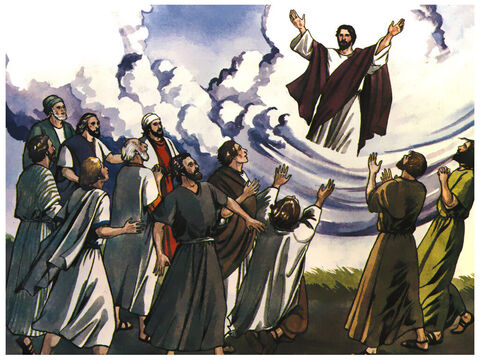
PRESENT: The gospels
conclude with Christ ascending to heaven and to His coronation as the Cosmic
King. Paul explains what the Father did as a result of the crucifixion: He raised Him [Jesus] from the dead and seated Him at His right hand in the heavenly
realms, far above all rule and authority, power and dominion, and every title
that can be given, not only in the present age
but also in the one to come (Ephesians 1:20,21).
FUTURE:
Jesus Christ is the Ultimate Conqueror charged with meting out the judgement of
God at His appointed time. John describes it this way in The Revelation: I saw heaven standing open and there before
me was a white horse, whose Rider is called Faithful and True. With justice He
judges and wages war. His eyes are like blazing fire, and on His head are many
crowns. He has a name written on Him that no one knows but He Himself. He is
dressed in a robe dipped in blood, and His name is the Word of God (Revelation
19:11-13).
Takeaway: As a citizen of that kingdom, does my life reflect the values of the invisible Kingdom of Heaven? Am I awaiting His return as my King? And, am I a prism through which the King’s glory is refracted to my dark, broken world?
~graphic by freebibleimages.org
- this post last appeared in December 2019