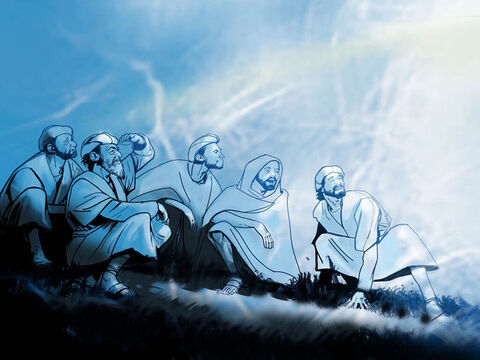
When the angels went away from them into heaven, the shepherds said to one another, “Let us go over to Bethlehem and see this thing that has happened, which the Lord has made known to us” (Luke 2:15).
Of all the people in Israel during the final months of Herod’s reign, why would the angels make known the birth of the Christ-child to shepherds?
Why not to Galilean fishermen? Or to godly priests labouring
in the Temple? Or to merchants, stone masons, crop-farmers, homemakers?
Shepherds were among the lower classes of 1st
century Jewish culture; they lived with animals in isolated, desolate places.
For extended periods of time, they had little contact with those living in the
towns and cities.
Although highly skilled at their vocation, theirs was a
solitary, lonely life of meagre rations and limited opportunity.
And when the possessions of rural village-dwellers went
missing, those nomadic shepherds were often the first to be accused.
But these shepherds, in the eternal plan of Almighty God,
were the first to hear the seismically history-altering announcement: For unto you is born this day
in the city of David a Savior, who is Christ the Lord
(v.11).
And the link to the ‘shepherd motif’ of ancient references to the God of Israel and Messianic predictions comes into focus.
Isaiah begins
the 2nd major section of his mammoth prophetic oracle in chapter 40
with words of comfort. He predicts the coming of John the Baptist: A voice cries: In the
wilderness prepare the way of the Lord…And the glory of the Lord shall be revealed
(Isaiah 40:3,5)
And then directs his attention to the One who
would follow John:
He will tend his flock like a
shepherd;
he will gather the lambs in his arms;
he will carry them in his
bosom,
and gently lead those that are with young (v.11).
Isaiah’s contemporary was the minor prophet Micah and in the same passage as Micah predicts the town of Bethlehem as the birthplace of the Saviour, the prophet declares:
And he shall stand and shepherd his
flock in the strength of the Lord… (Micah 5:4)
The Messiah
would be the Son of King David, including being the Shepherd-King like His forefather
a millennia before.
He is the Shepherd to His sheep, delivering guidance, protection, provision…forever.
Takeaway: As you reflect on the blockbuster announcement to the shepherds that
first Christmas night, may you more deeply treasure the Great Shepherd of His
sheep.
Think of His
words from John 10:
But he who enters by the door is the Shepherd
of the sheep...The sheep hear his voice, and he calls his own sheep by name and
leads them out (v.2,3).
I am the Good Shepherd. I know my own
and my own know me, just as the Father knows
me and I know the Father; and I lay down my life for the sheep (v.14,15).
~ graphic from freebibleimages.org
- this post
last appeared in December 2022